Dungeons & Dragons
Dungeons & Dragons (D&D) is the world’s most popular tabletop role-playing game (TTRPG), first published in 1974 by Gary Gygax and Dave Arneson. It’s a collaborative storytelling game where players create characters—such as fighters, wizards, or rogues—and embark on adventures in a fantasy world. One player acts as the Dungeon Master (DM), serving as storyteller and referee, describing settings, controlling non-player characters, and guiding the narrative.
Gameplay involves dice rolls, character sheets, and imagination. Players solve puzzles, fight monsters, and explore dungeons, gaining experience points to level up. Unlike traditional board games, the goal isn’t to “win” but to create an immersive story together. D&D has influenced video games, books, and pop culture, and remains a cornerstone of modern gaming.
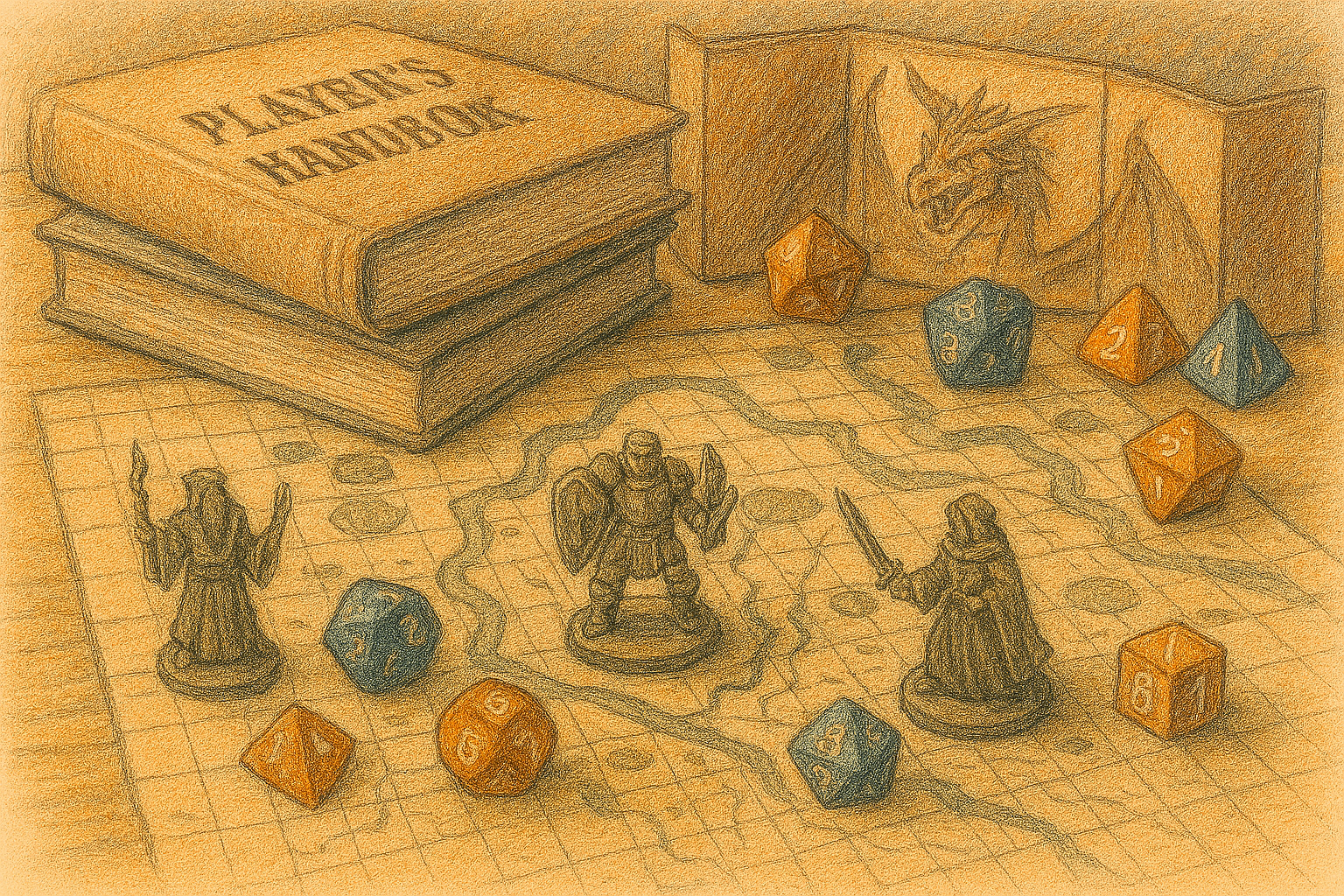
Abridged History of Dungeons and Dragons
Origins and Early Editions: Dungeons & Dragons debuted in 1974, created by Gary Gygax and Dave Arneson as the first tabletop role‑playing game. It combined fantasy storytelling with miniature wargaming, introducing players to character‑driven adventures guided by a Dungeon Master. By 1977, the game split into two lines: Basic D&D for newcomers and Advanced Dungeons & Dragons (AD&D) for more complex play. These versions evolved through the 1980s, culminating in AD&D 2nd Edition in 1989 and the comprehensive Rules Cyclopedia in 1991.
Modernization and Expansion: Wizards of the Coast acquired D&D in 1997, ushering in the 3rd Edition in 2000. This version introduced the d20 System and the Open Game License (OGL), allowing third‑party publishers to create compatible content—a move that fueled massive growth. A revision, 3.5, followed in 2003. The 4th Edition launched in 2008 with a focus on tactical combat and digital tools, but its changes sparked mixed reactions. In 2014, 5th Edition arrived, streamlining rules and emphasizing storytelling, which helped D&D surge in popularity through streaming and pop culture. A revised 5e ruleset launched in 2024. Today, D&D remains a cornerstone of gaming culture, blending tradition with modern accessibility and continuing to inspire collaborative storytelling worldwide.
Play Dungeons & Dragons
Step 1: Find Players
- A group of friends (usually 3–6) and one Dungeon Master (DM).
- Players and open games can commonly be found at local gaming stores.
- Online gaming is an excellent option for remote players.
Step 2: Gather Your Essentials
- Get The Rules: Talk to the Dungeon Master and other palyers. Decide what rules you will be using. You might use the standard Rules as Written (RAW) or you might use other rules from third party publishers, or rules your group makes for yourselves.
- Player’s Handbook -or-
- The Free Basic Rule set available on D&D Beyond
- Dice set, especially a 20-sided die
-or- any digital dice roller. - Paper & Pencil
-or- Printed Character Sheet
-or- D&D Beyond or similar apps for easy character creation and rules reference. - There is lots of optional equipment and materials, but this is all you need to get started.
Step 3: Understand the Roles
- Dungeon Master (DM): Narrates the story, controls non-player characters, and adjudicates rules.
- Players: Each creates a character with a species (e.g., elf, human) and class (e.g., fighter, wizard) and role-plays their actions in the shared world.
Step 4: Create Your Character
- Choose a species, class, and background.
- Roll or assign ability scores (Strength, Dexterity, etc.).
- Fill out your character sheet with stats, equipment, and personality traits.
Step 5: Learn the Core Loop
- Setup: DM describes the scene.
- Decision: Players declare what their characters do.
- Result: Dice rolls and rules determine success or failure.
Step 6: Start Playing
- Role-play your character’s actions and interact with the world.
- Work as a team to solve puzzles, fight monsters, and explore.
- Remember: The goal isn’t to “win” but to tell a great story together.
- Learn More:
How Tp Play D&D on D&D Beyond